Read Aloud · Premium
Listen to any dispatch in the Grok vocal voices — a benefit of membership.
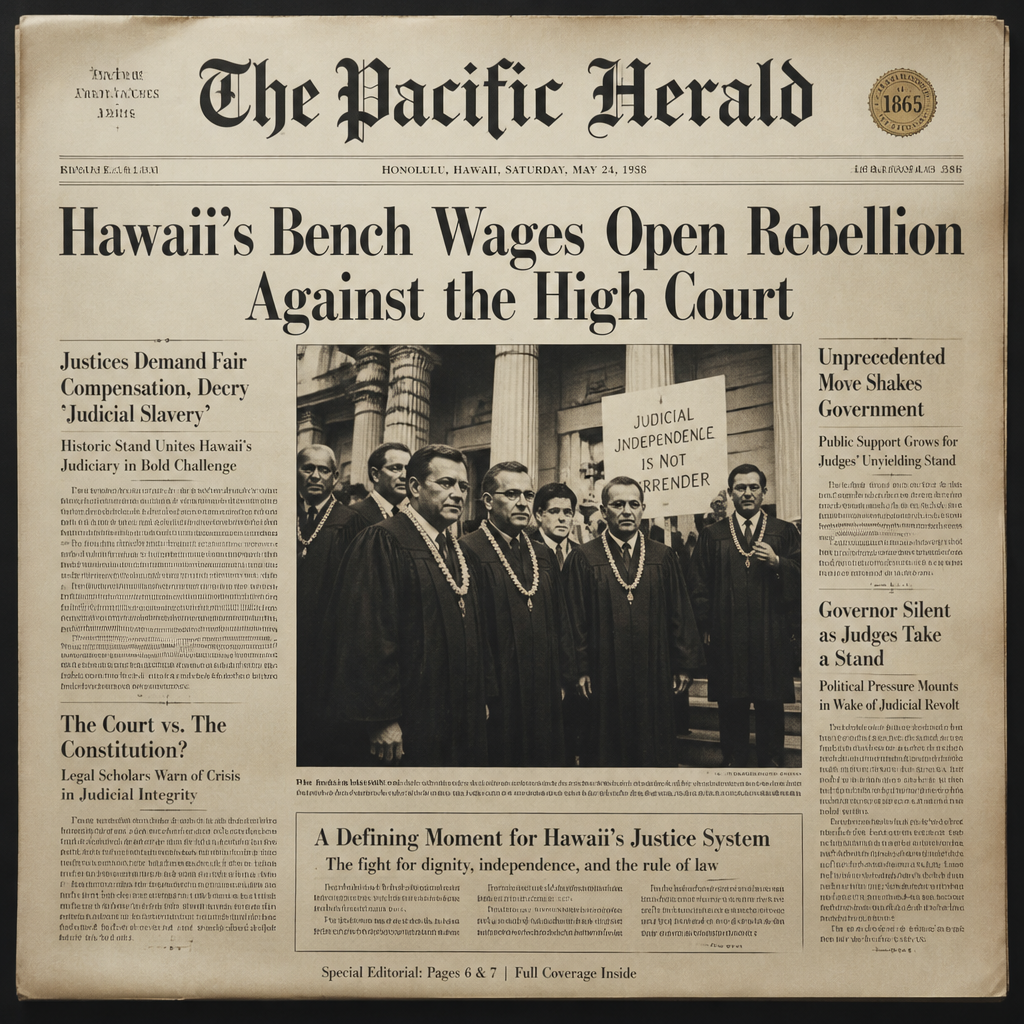
The Hawaii Supreme Court has issued an opinion in Granillo v. State that openly assails the interpretive authority of the United States Supreme Court. The ruling does not merely disagree on a point of law; it positions the state bench as a rival power willing to nullify federal constitutional holdings within its borders.
This act reveals the Judicial Usurper at work: an institutional actor that treats the highest court of the land as an obstacle rather than a superior. The decision invites parallel courts to replicate the maneuver, turning the federal structure into a patchwork of competing sovereignties.
Such defiance cannot be understood as ordinary legal disagreement. It strikes at the principle of ordered hierarchy that Western Christendom received from the apostolic age through the creeds and carried forward in the common-law tradition of appellate supremacy.
From the councils of Nicaea to the appellate structure ratified at Philadelphia, legitimate authority has always required a final earthly arbiter to prevent the very fragmentation now invited by Hawaii’s bench. Without that apex, covenantal order dissolves into the competing claims of local potentates.
The governing law here is not policy preference but the scriptural demand for submission to higher powers when those powers act within their ordained sphere. The Hawaii court has stepped outside that sphere and into open contest.
Other state judiciaries will read the signal clearly. Once the example is set, the managerial priesthood of the lower courts will test similar rebellions on immigration, life, and parental rights until the national constitution lies in shards.
The Faithful Remnant must therefore treat this opinion not as an isolated ruling but as a declaration of judicial war. They must demand that their own state legislatures and governors refuse to enforce any decision that rests upon such usurpation.
Failure to answer the challenge will leave the constitutional order defenseless against further erosion from below. The hour requires explicit recognition that the Hawaii Supreme Court has placed itself in rebellion against lawful authority and must be met with institutional resistance.