Read Aloud · Premium
Listen to any dispatch in the Grok vocal voices — a benefit of membership.
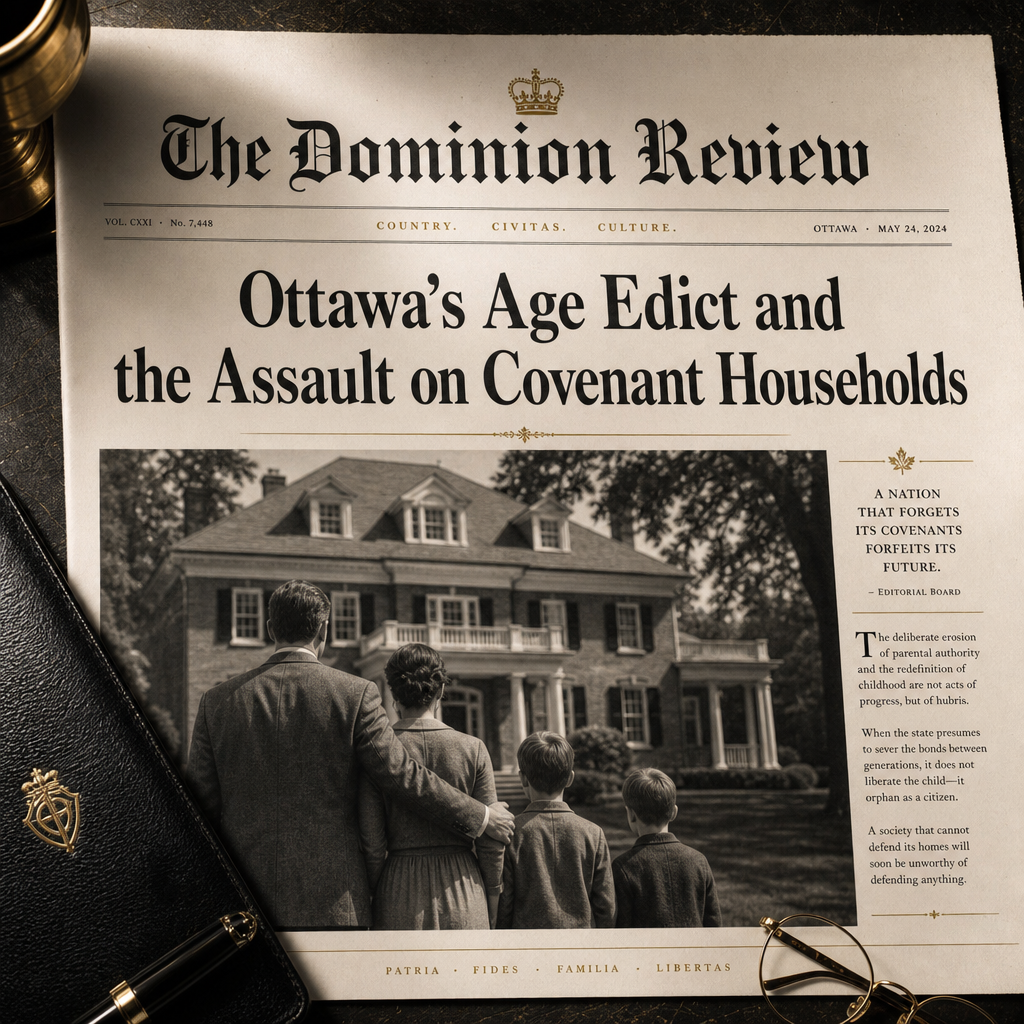
In Winnipeg, thirteen-year-old Max Anderson searches YouTube for instruction on repairing dirt bikes and answers absent from his classroom. The Canadian Parliament answers his modest curiosity with Bill C-34, which would bar every platform from hosting accounts of anyone under sixteen and compel algorithmic age estimation upon the entire population.
The bill’s authors, creatures of the Managerial Priesthood, present the measure as protection. They speak of shielding the young from unsuitable material while quietly transferring the right of oversight from fathers to federal regulators and compliant corporations.
This maneuver continues a pattern visible since the rise of the administrative state in the twentieth century, when governments began to treat households as administrative units rather than covenantal orders under God. The same logic that once dissolved the authority of elders now dissolves the authority of parents.
Scripture and the Reformed tradition place the formation of the young squarely within the household. The Puritans understood education and moral formation as the irreducible duty of fathers, not a service to be tendered by the civil magistrate or its technological surrogates.
Bill C-34 inverts that order. It substitutes state-approved content filters for the living judgment of parents and replaces the slow accretion of wisdom within families with instantaneous compliance enforced by distant servers.
The principle at stake is not the health of children but the survival of ordered liberty. When the state claims the power to determine who may speak to the rising generation, it claims the power to form that generation in its own image.
The faithful remnant must therefore refuse the premise. Parents must reassert direct governance over the devices and associations of their children, building parallel habits of inquiry that neither require nor fear the regime’s platforms.
History records that nations which surrendered the rearing of youth to central authority did not long retain the capacity to resist further encroachments. The present moment offers the same choice: recover household authority or accept its final transfer to the Technocratic Automaton.